
If you are considering a home in a 55+ community, you may assume the rules are simple.
Someone living in the home must be at least 55, right?
That is part of it, but HOPA rules are more detailed than many buyers realize.
A community must meet federal requirements to operate as housing for older persons.
This means two communities advertised as “55+” can have very different residency rules.
Disclosure: This post may contain affiliate links, meaning I can earn commissions. If you decide to purchase through my links, it is at no cost to you.
What Does HOPA Stand For?
HOPA stands for the Housing for Older Persons Act. Congress passed the law in 1995 as an amendment to the federal Fair Housing Act.
The Fair Housing Act generally protects families with children under 18 from housing discrimination based on familial status.
HOPA creates a limited exemption for qualifying housing intended for older people.
This exemption allows a qualified community to establish age-related occupancy rules that could otherwise violate familial-status protections.
HOPA does not remove the Fair Housing Act’s other protections. A qualifying community cannot use HOPA to discriminate based on race, color, national origin, religion, sex, or disability.
State and local laws may provide additional protections.
What Is HOPA?
HOPA is the federal framework that allows certain communities to legally operate as housing for older persons.
It is not a type of mortgage, property deed, house, or assisted living program. It also does not mean that residents receive health care or personal assistance.
The law focuses on who may occupy housing within a qualifying community. It can apply to several types of housing, including:
- Single-family subdivisions
- Condominium communities
- Cooperatives
- Apartment communities
- Manufactured home communities
- Mobile home parks
- Tiny home communities
- Properties under common ownership or management
Under federal regulations, a housing facility or community generally means a dwelling or group of dwellings governed by a common set of rules, restrictions, or regulations.
An individual home outside such a community does not usually become a “HOPA house” by itself.
Federal HOPA regulations provide examples of the housing arrangements that may qualify.
The Three Types of Housing for Older Persons
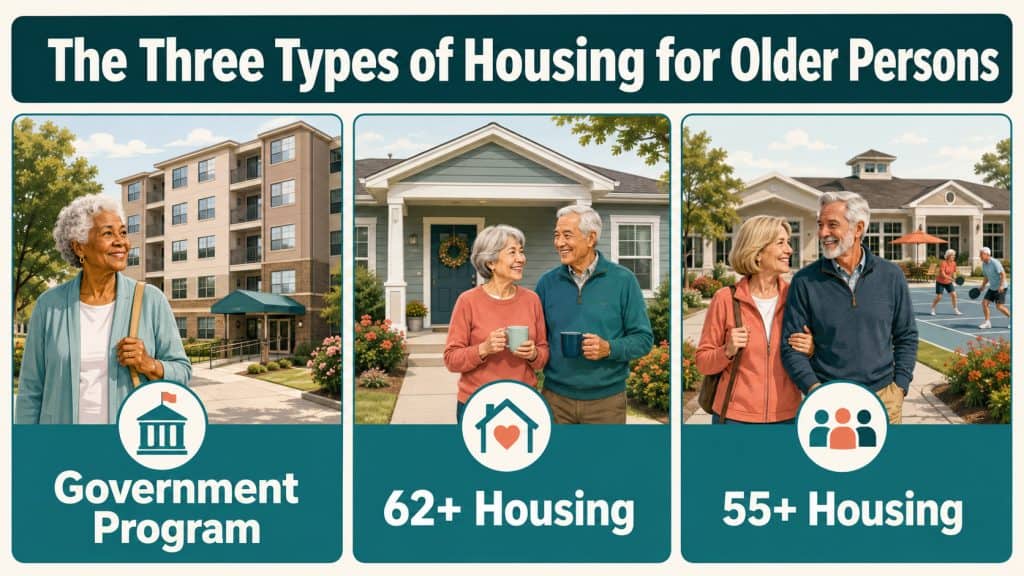
Federal law recognizes three main categories of housing for older persons.
Housing Provided Through a Government Program
The first category covers housing provided through a state or federal program that HUD determines is designed and operated to assist older people.
The program’s rules generally establish who qualifies as an older person.
Housing for People 62 or Older
The second category covers housing intended for and solely occupied by people who are at least 62 years old.
This standard is stricter than the 55+ standard. With limited exceptions, everyone occupying the housing must be 62 or older.
For example, federal regulations make an exception for certain employees who live on the property and perform substantial management or maintenance duties.
Housing for People 55 or Older
The third and most commonly discussed category is housing intended and operated for people who are at least 55.
Most private active adult communities rely on this category.
These communities do not have to require every resident to be 55 or older, but they must meet the federal HOPA requirements.
HOPA Requirements for a 55+ Community
A community claiming the 55+ exemption generally must satisfy three main requirements:
- At least 80% of its occupied units must have at least one occupant who is 55 or older.
- The community must publish and follow policies showing that it intends to operate as housing for people 55 or older.
- The community must have reliable procedures for verifying residents’ ages and update its information at least once every two years.
Meeting only the 80% requirement is not enough.
The community’s governing documents, advertising, leasing practices, age-verification records, and actual operations should support its claim that it is intended for older residents.
Understanding the HOPA 80/20 Rule
The HOPA 80/20 rule is one of the most misunderstood parts of age-restricted housing.
At least 80% of the occupied units must have at least one occupant who is 55 or older.
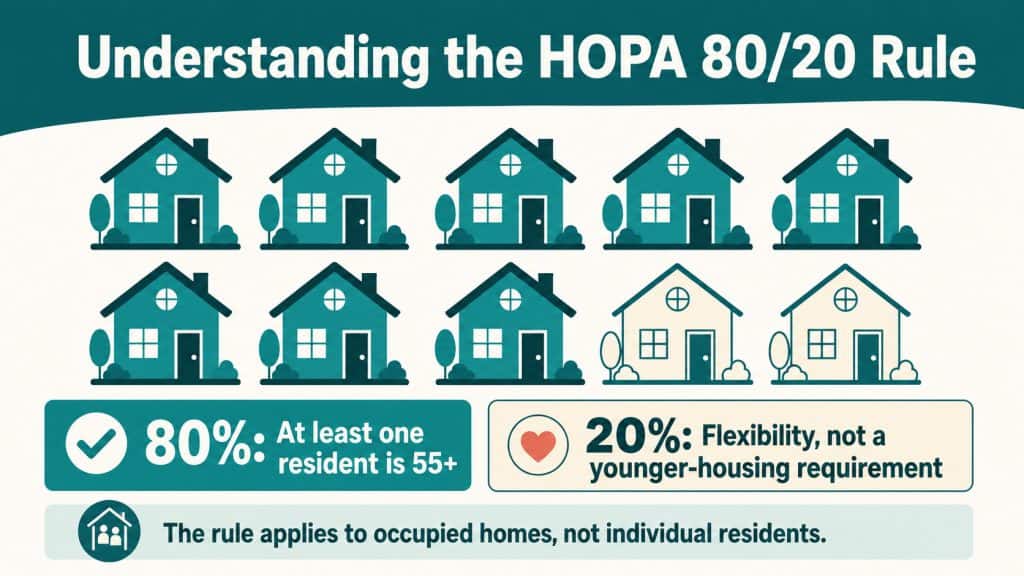
The calculation is based on occupied units, not individual residents.
For example, imagine a community has 100 occupied homes. At least 80 of those homes must have one or more occupants who are at least 55.
The other people living in those qualifying homes do not necessarily have to be 55. A 58-year-old resident might live with a 52-year-old spouse.
That home can still count toward the community’s 80% because at least one occupant is 55 or older.
Vacant homes generally are not included in the occupied-unit calculation.
Federal rules may count a temporarily vacant home as occupied when the primary occupant lived there during the previous year and intends to return periodically.
Does the Other 20% Have to Be Open to Younger Residents?
No. HOPA does not require a community to let younger households occupy 20% of its homes.
This is the key point many buyers miss.
The federal regulation allows each community to decide what age restrictions apply to units outside the qualifying 80%.
A community may use that flexibility for younger spouses, surviving residents, inherited homes, caregivers, or other situations.
It may also adopt a stricter policy that requires every occupied home to have someone who is 55 or older.
The 20% is a legal allowance, not a guaranteed set of homes for buyers under 55.
Does Everyone in a 55+ Community Have to Be 55?
Not necessarily.
Under the federal 55+ standard, only one occupant in at least 80% of the occupied units must be 55 or older.
A community may permit a younger spouse, partner, adult child, roommate, or caregiver to live with that person.

The community’s own documents may be stricter. For example, a community could require:
- At least one occupant in every home to be 55 or older
- All other permanent residents to be at least 18
- A younger spouse to be at least 40
- Board or management approval for certain occupants
- A new qualifying resident when the original 55+ resident leaves
Do not assume that meeting the federal minimum gives you the right to live in a specific community.
Always read the declaration, bylaws, occupancy policy, lease terms, and community rules.
Can Someone Under 55 Buy a Home in a 55+ Community?
Possibly. HOPA primarily deals with occupancy, but community documents may also place conditions on ownership, leasing, or resale.
Some communities allow a younger person to own a home as an investment, inherit a property, or purchase it for an older family member.

That does not always mean the younger owner may live there.
Other communities may require at least one owner or buyer to meet the age requirement.
Before purchasing, ask two separate questions:
- Can a person under 55 own the home?
- Can a person under 55 occupy the home?
The answers may not be the same.
Can Children Live in a 55+ Community?
A qualifying HOPA community may restrict families with children under 18 because it is exempt from the Fair Housing Act’s familial-status protections.
That does not mean every HOPA community completely prohibits children.

Federal regulations allow a 55+ community to admit families with children as long as the community continues meeting the 80% occupancy requirement and maintains its intent to operate as housing for people 55 or older.
The community’s governing documents will usually address whether children may:
- Live in the home permanently
- Stay during school breaks
- Visit for a set number of days
- Use the pool or clubhouse
- Move in during an emergency
- Live with a grandparent who has legal custody
Some communities prohibit permanent residents under 18 but permit visits.
Others limit the number of days a child may stay during a calendar year.
Ask for the rule in writing. A verbal explanation from a salesperson, homeowner, or neighbor may not match the recorded restrictions.
Family Visits and Guest Rules
Grandchildren and other younger family members can usually visit a 55+ community, but the length and conditions of the visit may be limited.

Guest rules may address:
- The number of consecutive days a guest may stay
- The total number of guest days allowed each year
- Whether the homeowner must be present
- Registration requirements
- Parking restrictions
- Adult supervision at community amenities
- Quiet hours and other conduct rules
These rules become especially important if you expect grandchildren to spend summers with you or if an adult child may need temporary housing.
You should also ask what happens during an emergency.
A community may have a process for temporary exceptions, but you should not assume one will be granted.
Caregivers and Reasonable Accommodations
HOPA does not cancel the Fair Housing Act’s disability protections.
Federal regulations recognize that a person under 55 may need to live in the community to provide a reasonable accommodation to a resident with a disability.
This could include a live-in aide or another person whose presence is necessary because of the resident’s disability.

The community should evaluate a reasonable-accommodation request based on the individual circumstances.
It should not automatically deny the request simply because the caregiver is younger than the community’s stated age limit.
Residents may still need to follow the community’s application and documentation process.
What Happens When the Qualifying Resident Dies or Moves?
The outcome depends heavily on the community’s governing documents and the household’s circumstances.
Consider a home occupied by a 58-year-old resident and a 52-year-old spouse.
If the older spouse dies or permanently moves away, the remaining spouse may no longer satisfy the community’s standard for a qualifying unit.
Some communities allow the younger spouse to remain. Others make an exception only if the community stays above the 80% threshold.
Some may require the younger resident to reach a certain age or sell the home within a stated period.
Similar issues can arise after divorce, separation, inheritance, or a move into assisted living.
Buyers should review these possibilities before purchasing, especially when one spouse is much younger than the other.
How Communities Verify a Resident’s Age
A community cannot simply call itself 55+ and rely on assumptions about its residents.
It must be able to verify that it meets the federal occupancy standard.
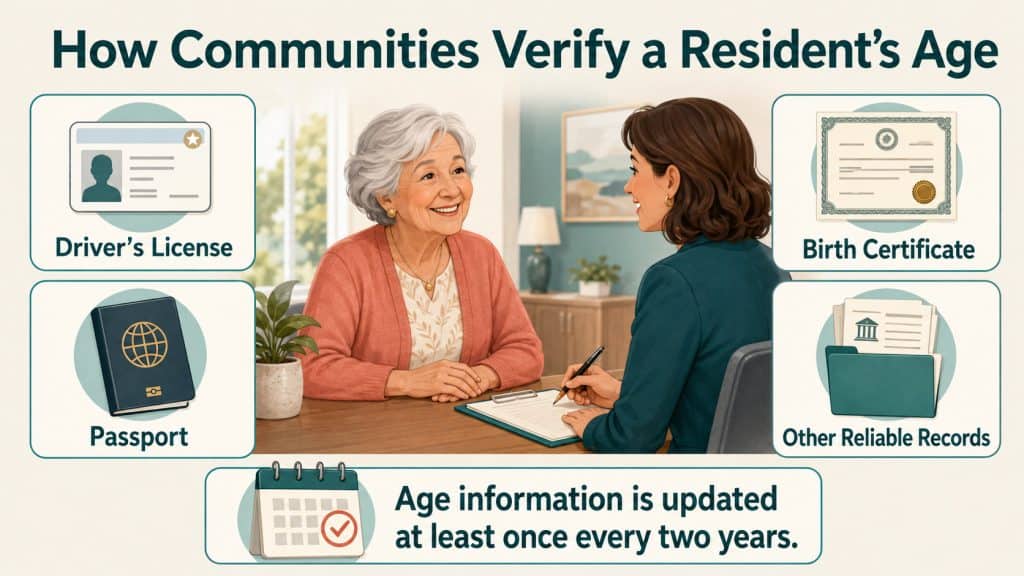
HUD regulations identify several acceptable forms of age verification, including:
- Driver’s license
- Birth certificate
- Passport
- Immigration card
- Military identification
- Other official documents showing a reliable birth date
- A signed certification in a lease, application, affidavit, or similar document
The community must establish procedures for determining who occupies each unit and whether at least one occupant is 55 or older.
It must update this information at least once every two years.
A summary of the community’s occupancy survey must also be available for inspection after reasonable notice and a request.
This does not necessarily mean that the community must make residents’ private identification documents available to the public.
HUD’s age-verification requirements explain the records a community may use and maintain.
How a Community Shows Its Intent to Operate as 55+ Housing
A community must publish and follow policies that clearly show its intent to operate as housing for people 55 or older.
HUD may consider factors such as:
- How the community describes itself to prospective residents
- Advertising and marketing materials
- Lease language
- Recorded covenants and deed restrictions
- Written occupancy policies
- Consistent application of age requirements
- The community’s actual operating practices
- Public notices identifying the property as 55+ housing
Simply using phrases such as “adult living” or “adult community” is not enough to show HOPA intent.
The community’s actions should match its written policies. Repeatedly allowing unapproved exceptions while still advertising the property as strictly age-restricted could create a compliance problem.
Is There a HOPA Certification?
People often refer to a community being “HOPA certified,” but HOPA is not generally a one-time federal certification that a community receives and keeps forever.
A community must be able to demonstrate ongoing compliance with the law.
This includes maintaining the required percentage of qualifying occupied units, following its stated policies, and keeping current age-verification records.
Buyers should not rely only on a sign or website that says “55+.”
They can ask the association or management company how the community documents its HOPA status and whether it has completed its required occupancy updates.
HOPA Compliance for Community Boards and Managers
HOPA compliance should be treated as an ongoing responsibility, not a task that comes up only when someone files a complaint.
Boards and managers should:
- Maintain a current list of occupied and vacant units
- Identify the qualifying resident in each counted unit
- Verify ages when people buy, lease, or move into homes
- Update occupancy information at least every two years
- Store sensitive records securely
- Apply occupancy and guest rules consistently
- Review advertisements and application materials
- Plan for deaths, divorces, inheritances, and caregiver requests
- Seek legal advice before changing age restrictions
A management company can help organize surveys, records, reminders, and applications.
It cannot replace legal advice when a board faces a dispute or possible loss of HOPA status.
HOPA, Zoning, and Real Estate Development
HOPA allows qualifying housing communities to limit occupancy based on age. It does not replace local zoning, building codes, land-use rules, or development approvals.
A developer creating a 55+ subdivision, manufactured home community, apartment complex, or tiny home community may need to address two separate areas:
- Local approval to build and operate the development
- Federal and state requirements to operate it as age-restricted housing
Some local governments may have zoning classifications or development standards for senior housing.
Those local accommodations come from local law and planning decisions, not automatically from HOPA.
Developers may choose a 55+ model because older buyers often want smaller homes, reduced maintenance, shared amenities, and a strong social setting.
HOPA provides the legal framework for age-restricted occupancy, but it does not guarantee that a project will receive zoning approval.
Questions to Ask Before Buying in a 55+ Community
Before you make an offer, ask for written answers to these questions:
- Who must be 55 or older?
- Is there a minimum age for other permanent occupants?
- Can a younger spouse or partner live in the home?
- Can adult children live with the owner?
- How long may children or grandchildren visit?
- Are children allowed to use all community amenities?
- What happens if the qualifying resident dies or moves?
- May a younger spouse remain in the home?
- Can someone under 55 inherit, own, or occupy the property?
- Are rentals allowed?
- Do tenants have to meet the same age rules as owners?
- How often does the community verify occupancy?
- Is the community currently meeting its HOPA requirements?
- Are there exceptions for live-in caregivers?
- Where are the occupancy and guest rules recorded?
You should also review the declaration, bylaws, rules, lease restrictions, recent budgets, HOA fees, and resale requirements.
HOPA compliance is important, but it is only one part of evaluating a community.
Final Thoughts
HOPA gives qualifying communities a legal path to offer housing intended for older residents.
It does not create one universal set of rules for every 55+ community.
One community may welcome a younger spouse, allow extended visits from grandchildren, and make exceptions for inherited homes. Another community may have much stricter occupancy rules.
The biggest mistake a buyer can make is relying on the “55+” label without reading the actual documents.
Before purchasing or leasing, review the age restrictions, occupancy policy, guest rules, inheritance provisions, rental restrictions, and caregiver procedures.
If a rule could affect your ability to live in or keep the home, get an answer in writing and consider having a qualified attorney review it.
This article provides general educational information and is not legal advice. HOPA requirements and community rules can involve federal, state, and local law. Consult a qualified attorney about a specific community or housing situation.
Frequently asked Questions
Is HOPA the Same as an HOA?
No. HOPA is the federal law that allows qualifying housing to operate for older persons. An HOA is an organization that manages or governs a community.
Is an Active Adult Community the Same as Assisted Living?
No. An active adult community usually offers independent housing, amenities, activities, and an age-focused lifestyle.
Does HOPA Mean All Residents Must Be Retired?
No. HOPA uses age and occupancy requirements. It does not require residents to be retired. A qualifying resident may continue working full-time or part-time.
Can Grandchildren Visit a 55+ Community?
Usually, but the community may limit the length of visits or access to certain amenities. Read the community’s guest rules before assuming that extended visits are allowed.
Can a Younger Spouse Live in a 55+ Community?
Often, yes. At least one occupant in a qualifying unit must be 55 or older under the federal standard. The community may set a separate minimum age for a spouse or other permanent resident.
Can a Younger Spouse Stay After the Older Spouse Dies?
Possibly. The community documents may allow the younger spouse to remain, but the answer depends on the rules and the community’s occupancy status.
Does the 80/20 Rule Mean 20% of the Homes Must Accept Younger Residents?
No. HOPA does not require a community to reserve 20% of its homes for younger residents. The community may decide how or whether to allow households without a resident who is at least 55.
Does HOPA Apply to Tiny Home and Manufactured Home Communities?
It can. Federal regulations specifically recognize mobile home parks and manufactured housing communities as possible housing facilities or communities.
Author

Image Source: Canva, Pexels, Pixabay, Open Verse, Unsplash